OpenAI Codex CLI
Lightweight coding agent that runs in your terminal
npm i -g @openai/codex
---
Table of Contents
- [Experimental Technology Disclaimer](#experimental-technology-disclaimer)
- [Quickstart](#quickstart)
- [Why Codex?](#whycodex)
- [Security Model \& Permissions](#securitymodelpermissions)
- [Platform sandboxing details](#platform-sandboxing-details)
- [System Requirements](#systemrequirements)
- [CLI Reference](#clireference)
- [Memory \& Project Docs](#memoryprojectdocs)
- [Non‑interactive / CI mode](#noninteractivecimode)
- [Recipes](#recipes)
- [Installation](#installation)
- [Configuration](#configuration)
- [FAQ](#faq)
- [Funding Opportunity](#funding-opportunity)
- [Contributing](#contributing)
- [Development workflow](#development-workflow)
- [Nix Flake Development](#nix-flake-development)
- [Writing high‑impact code changes](#writing-highimpact-code-changes)
- [Opening a pull request](#opening-a-pull-request)
- [Review process](#review-process)
- [Community values](#community-values)
- [Getting help](#getting-help)
- [Contributor License Agreement (CLA)](#contributor-license-agreement-cla)
- [Quick fixes](#quick-fixes)
- [Releasing `codex`](#releasing-codex)
- [Security \& Responsible AI](#securityresponsibleai)
- [License](#license)
- [Zero Data Retention (ZDR) Organization Limitation](#zero-data-retention-zdr-organization-limitation)
---
## Experimental Technology Disclaimer
Codex CLI is an experimental project under active development. It is not yet stable, may contain bugs, incomplete features, or undergo breaking changes. We’re building it in the open with the community and welcome:
- Bug reports
- Feature requests
- Pull requests
- Good vibes
Help us improve by filing issues or submitting PRs (see the section below for how to contribute)!
## Quickstart
Install globally:
```shell
npm install -g @openai/codex
```
Next, set your OpenAI API key as an environment variable:
```shell
export OPENAI_API_KEY="your-api-key-here"
```
> **Note:** This command sets the key only for your current terminal session. You can add the `export` line to your shell's configuration file (e.g., `~/.zshrc`) but we recommend setting for the session. **Tip:** You can also place your API key into a `.env` file at the root of your project:
>
> ```env
> OPENAI_API_KEY=your-api-key-here
> ```
>
> The CLI will automatically load variables from `.env` (via `dotenv/config`).
Use --provider to use other models
> Codex also allows you to use other providers that support the OpenAI Chat Completions API. You can set the provider in the config file or use the `--provider` flag. The possible options for `--provider` are:
>
> - openai (default)
> - openrouter
> - gemini
> - ollama
> - mistral
> - deepseek
> - xai
> - groq
>
> If you use a provider other than OpenAI, you will need to set the API key for the provider in the config file or in the environment variable as:
>
> ```shell
> export _API_KEY="your-api-key-here"
> ```
Run interactively:
```shell
codex
```
Or, run with a prompt as input (and optionally in `Full Auto` mode):
```shell
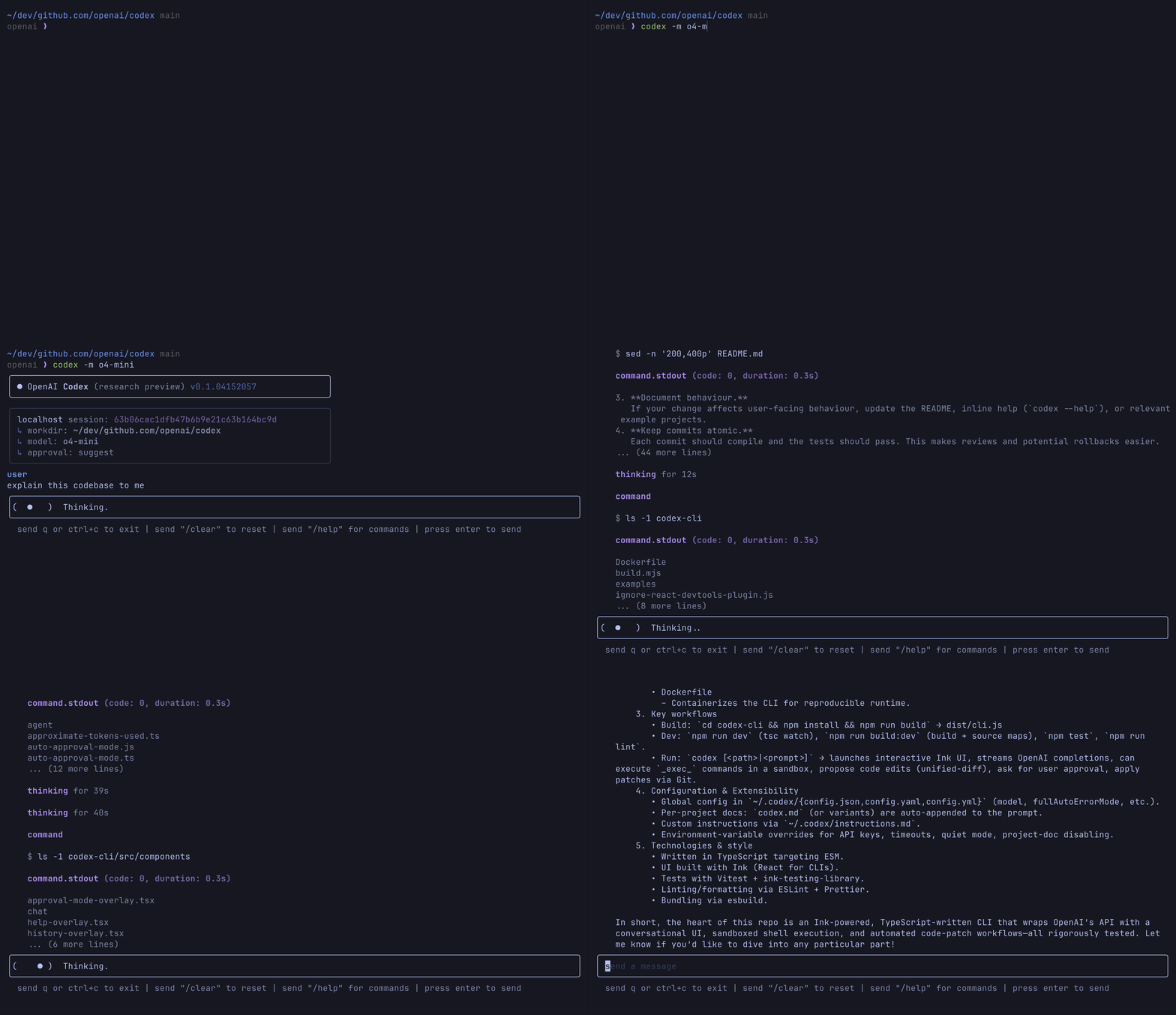
codex "explain this codebase to me"
```
```shell
codex --approval-mode full-auto "create the fanciest todo-list app"
```
That’s it – Codex will scaffold a file, run it inside a sandbox, install any
missing dependencies, and show you the live result. Approve the changes and
they’ll be committed to your working directory.
---
## Why Codex?
Codex CLI is built for developers who already **live in the terminal** and want
ChatGPT‑level reasoning **plus** the power to actually run code, manipulate
files, and iterate – all under version control. In short, it’s _chat‑driven
development_ that understands and executes your repo.
- **Zero setup** — bring your OpenAI API key and it just works!
- **Full auto-approval, while safe + secure** by running network-disabled and directory-sandboxed
- **Multimodal** — pass in screenshots or diagrams to implement features ✨
And it's **fully open-source** so you can see and contribute to how it develops!
---
## Security Model & Permissions
Codex lets you decide _how much autonomy_ the agent receives and auto-approval policy via the
`--approval-mode` flag (or the interactive onboarding prompt):
| Mode | What the agent may do without asking | Still requires approval |
| ------------------------- | -------------------------------------------------------------------------------------------------- | ----------------------------------------------------------------------------------------------- |
| **Suggest**
(default) | • Read any file in the repo | • **All** file writes/patches
• **Any** arbitrary shell commands (aside from reading files) |
| **Auto Edit** | • Read **and** apply‑patch writes to files | • **All** shell commands |
| **Full Auto** | • Read/write files
• Execute shell commands (network disabled, writes limited to your workdir) | – |
In **Full Auto** every command is run **network‑disabled** and confined to the
current working directory (plus temporary files) for defense‑in‑depth. Codex
will also show a warning/confirmation if you start in **auto‑edit** or
**full‑auto** while the directory is _not_ tracked by Git, so you always have a
safety net.
Coming soon: you’ll be able to whitelist specific commands to auto‑execute with
the network enabled, once we’re confident in additional safeguards.
### Platform sandboxing details
The hardening mechanism Codex uses depends on your OS:
- **macOS 12+** – commands are wrapped with **Apple Seatbelt** (`sandbox-exec`).
- Everything is placed in a read‑only jail except for a small set of
writable roots (`$PWD`, `$TMPDIR`, `~/.codex`, etc.).
- Outbound network is _fully blocked_ by default – even if a child process
tries to `curl` somewhere it will fail.
- **Linux** – there is no sandboxing by default.
We recommend using Docker for sandboxing, where Codex launches itself inside a **minimal
container image** and mounts your repo _read/write_ at the same path. A
custom `iptables`/`ipset` firewall script denies all egress except the
OpenAI API. This gives you deterministic, reproducible runs without needing
root on the host. You can use the [`run_in_container.sh`](./codex-cli/scripts/run_in_container.sh) script to set up the sandbox.
---
## System Requirements
| Requirement | Details |
| --------------------------- | --------------------------------------------------------------- |
| Operating systems | macOS 12+, Ubuntu 20.04+/Debian 10+, or Windows 11 **via WSL2** |
| Node.js | **22 or newer** (LTS recommended) |
| Git (optional, recommended) | 2.23+ for built‑in PR helpers |
| RAM | 4‑GB minimum (8‑GB recommended) |
> Never run `sudo npm install -g`; fix npm permissions instead.
---
## CLI Reference
| Command | Purpose | Example |
| ------------------------------------ | ----------------------------------- | ------------------------------------ |
| `codex` | Interactive REPL | `codex` |
| `codex "…"` | Initial prompt for interactive REPL | `codex "fix lint errors"` |
| `codex -q "…"` | Non‑interactive "quiet mode" | `codex -q --json "explain utils.ts"` |
| `codex completion ` | Print shell completion script | `codex completion bash` |
Key flags: `--model/-m`, `--approval-mode/-a`, `--quiet/-q`, and `--notify`.
---
## Memory & Project Docs
Codex merges Markdown instructions in this order:
1. `~/.codex/instructions.md` – personal global guidance
2. `codex.md` at repo root – shared project notes
3. `codex.md` in cwd – sub‑package specifics
Disable with `--no-project-doc` or `CODEX_DISABLE_PROJECT_DOC=1`.
---
## Non‑interactive / CI mode
Run Codex head‑less in pipelines. Example GitHub Action step:
```yaml
- name: Update changelog via Codex
run: |
npm install -g @openai/codex
export OPENAI_API_KEY="${{ secrets.OPENAI_KEY }}"
codex -a auto-edit --quiet "update CHANGELOG for next release"
```
Set `CODEX_QUIET_MODE=1` to silence interactive UI noise.
## Tracing / Verbose Logging
Setting the environment variable `DEBUG=true` prints full API request and response details:
```shell
DEBUG=true codex
```
---
## Recipes
Below are a few bite‑size examples you can copy‑paste. Replace the text in quotes with your own task. See the [prompting guide](https://github.com/openai/codex/blob/main/codex-cli/examples/prompting_guide.md) for more tips and usage patterns.
| ✨ | What you type | What happens |
| --- | ------------------------------------------------------------------------------- | -------------------------------------------------------------------------- |
| 1 | `codex "Refactor the Dashboard component to React Hooks"` | Codex rewrites the class component, runs `npm test`, and shows the diff. |
| 2 | `codex "Generate SQL migrations for adding a users table"` | Infers your ORM, creates migration files, and runs them in a sandboxed DB. |
| 3 | `codex "Write unit tests for utils/date.ts"` | Generates tests, executes them, and iterates until they pass. |
| 4 | `codex "Bulk‑rename *.jpeg → *.jpg with git mv"` | Safely renames files and updates imports/usages. |
| 5 | `codex "Explain what this regex does: ^(?=.*[A-Z]).{8,}$"` | Outputs a step‑by‑step human explanation. |
| 6 | `codex "Carefully review this repo, and propose 3 high impact well-scoped PRs"` | Suggests impactful PRs in the current codebase. |
| 7 | `codex "Look for vulnerabilities and create a security review report"` | Finds and explains security bugs. |
---
## Installation
From npm (Recommended)
```bash
npm install -g @openai/codex
# or
yarn global add @openai/codex
# or
bun install -g @openai/codex
# or
pnpm add -g @openai/codex
```
Build from source
```bash
# Clone the repository and navigate to the CLI package
git clone https://github.com/openai/codex.git
cd codex/codex-cli
# Enable corepack
corepack enable
# Install dependencies and build
pnpm install
pnpm build
# Get the usage and the options
node ./dist/cli.js --help
# Run the locally‑built CLI directly
node ./dist/cli.js
# Or link the command globally for convenience
pnpm link
```
---
## Configuration
Codex looks for config files in **`~/.codex/`** (either YAML or JSON format).
```yaml
# ~/.codex/config.yaml
model: o4-mini # Default model
approvalMode: suggest # or auto-edit, full-auto
fullAutoErrorMode: ask-user # or ignore-and-continue
notify: true # Enable desktop notifications for responses
```
```json
// ~/.codex/config.json
{
"model": "o4-mini",
"approvalMode": "suggest",
"fullAutoErrorMode": "ask-user",
"notify": true
}
```
You can also define custom instructions:
```yaml
# ~/.codex/instructions.md
- Always respond with emojis
- Only use git commands if I explicitly mention you should
```
---
## FAQ
OpenAI released a model called Codex in 2021 - is this related?
In 2021, OpenAI released Codex, an AI system designed to generate code from natural language prompts. That original Codex model was deprecated as of March 2023 and is separate from the CLI tool.
Which models are supported?
Any model available with [Responses API](https://platform.openai.com/docs/api-reference/responses). The default is `o4-mini`, but pass `--model gpt-4.1` or set `model: gpt-4.1` in your config file to override.
Why does o3 or o4-mini not work for me?
It's possible that your [API account needs to be verified](https://help.openai.com/en/articles/10910291-api-organization-verification) in order to start streaming responses and seeing chain of thought summaries from the API. If you're still running into issues, please let us know!
How do I stop Codex from editing my files?
Codex runs model-generated commands in a sandbox. If a proposed command or file change doesn't look right, you can simply type **n** to deny the command or give the model feedback.
Does it work on Windows?
Not directly. It requires [Windows Subsystem for Linux (WSL2)](https://learn.microsoft.com/en-us/windows/wsl/install) – Codex has been tested on macOS and Linux with Node ≥ 22.
---
## Zero Data Retention (ZDR) Organization Limitation
> **Note:** Codex CLI does **not** currently support OpenAI organizations with [Zero Data Retention (ZDR)](https://platform.openai.com/docs/guides/your-data#zero-data-retention) enabled.
If your OpenAI organization has Zero Data Retention enabled, you may encounter errors such as:
```
OpenAI rejected the request. Error details: Status: 400, Code: unsupported_parameter, Type: invalid_request_error, Message: 400 Previous response cannot be used for this organization due to Zero Data Retention.
```
**Why?**
- Codex CLI relies on the Responses API with `store:true` to enable internal reasoning steps.
- As noted in the [docs](https://platform.openai.com/docs/guides/your-data#responses-api), the Responses API requires a 30-day retention period by default, or when the store parameter is set to true.
- ZDR organizations cannot use `store:true`, so requests will fail.
**What can I do?**
- If you are part of a ZDR organization, Codex CLI will not work until support is added.
- We are tracking this limitation and will update the documentation once support becomes available.
---
## Funding Opportunity
We’re excited to launch a **$1 million initiative** supporting open source projects that use Codex CLI and other OpenAI models.
- Grants are awarded in **$25,000** API credit increments.
- Applications are reviewed **on a rolling basis**.
**Interested? [Apply here](https://openai.com/form/codex-open-source-fund/).**
---
## Contributing
This project is under active development and the code will likely change pretty significantly. We'll update this message once that's complete!
More broadly we welcome contributions – whether you are opening your very first pull request or you’re a seasoned maintainer. At the same time we care about reliability and long‑term maintainability, so the bar for merging code is intentionally **high**. The guidelines below spell out what “high‑quality” means in practice and should make the whole process transparent and friendly.
### Development workflow
- Create a _topic branch_ from `main` – e.g. `feat/interactive-prompt`.
- Keep your changes focused. Multiple unrelated fixes should be opened as separate PRs.
- Use `pnpm test:watch` during development for super‑fast feedback.
- We use **Vitest** for unit tests, **ESLint** + **Prettier** for style, and **TypeScript** for type‑checking.
- Before pushing, run the full test/type/lint suite:
### Git Hooks with Husky
This project uses [Husky](https://typicode.github.io/husky/) to enforce code quality checks:
- **Pre-commit hook**: Automatically runs lint-staged to format and lint files before committing
- **Pre-push hook**: Runs tests and type checking before pushing to the remote
These hooks help maintain code quality and prevent pushing code with failing tests. For more details, see [HUSKY.md](./codex-cli/HUSKY.md).
```bash
npm test && npm run lint && npm run typecheck
```
- If you have **not** yet signed the Contributor License Agreement (CLA), add a PR comment containing the exact text
```text
I have read the CLA Document and I hereby sign the CLA
```
The CLA‑Assistant bot will turn the PR status green once all authors have signed.
```bash
# Watch mode (tests rerun on change)
pnpm test:watch
# Type‑check without emitting files
pnpm typecheck
# Automatically fix lint + prettier issues
pnpm lint:fix
pnpm format:fix
```
#### Nix Flake Development
Prerequisite: Nix >= 2.4 with flakes enabled (`experimental-features = nix-command flakes` in `~/.config/nix/nix.conf`).
Enter a Nix development shell:
```bash
nix develop
```
This shell includes Node.js, installs dependencies, builds the CLI, and provides a `codex` command alias.
Build and run the CLI directly:
```bash
nix build
./result/bin/codex --help
```
Run the CLI via the flake app:
```bash
nix run .#codex
```
### Writing high‑impact code changes
1. **Start with an issue.** Open a new one or comment on an existing discussion so we can agree on the solution before code is written.
2. **Add or update tests.** Every new feature or bug‑fix should come with test coverage that fails before your change and passes afterwards. 100 % coverage is not required, but aim for meaningful assertions.
3. **Document behaviour.** If your change affects user‑facing behaviour, update the README, inline help (`codex --help`), or relevant example projects.
4. **Keep commits atomic.** Each commit should compile and the tests should pass. This makes reviews and potential rollbacks easier.
### Opening a pull request
- Fill in the PR template (or include similar information) – **What? Why? How?**
- Run **all** checks locally (`npm test && npm run lint && npm run typecheck`). CI failures that could have been caught locally slow down the process.
- Make sure your branch is up‑to‑date with `main` and that you have resolved merge conflicts.
- Mark the PR as **Ready for review** only when you believe it is in a merge‑able state.
### Review process
1. One maintainer will be assigned as a primary reviewer.
2. We may ask for changes – please do not take this personally. We value the work, we just also value consistency and long‑term maintainability.
3. When there is consensus that the PR meets the bar, a maintainer will squash‑and‑merge.
### Community values
- **Be kind and inclusive.** Treat others with respect; we follow the [Contributor Covenant](https://www.contributor-covenant.org/).
- **Assume good intent.** Written communication is hard – err on the side of generosity.
- **Teach & learn.** If you spot something confusing, open an issue or PR with improvements.
### Getting help
If you run into problems setting up the project, would like feedback on an idea, or just want to say _hi_ – please open a Discussion or jump into the relevant issue. We are happy to help.
Together we can make Codex CLI an incredible tool. **Happy hacking!** :rocket:
### Contributor License Agreement (CLA)
All contributors **must** accept the CLA. The process is lightweight:
1. Open your pull request.
2. Paste the following comment (or reply `recheck` if you’ve signed before):
```text
I have read the CLA Document and I hereby sign the CLA
```
3. The CLA‑Assistant bot records your signature in the repo and marks the status check as passed.
No special Git commands, email attachments, or commit footers required.
#### Quick fixes
| Scenario | Command |
| ----------------- | ----------------------------------------------------------------------------------------- |
| Amend last commit | `git commit --amend -s --no-edit && git push -f` |
| GitHub UI only | Edit the commit message in the PR → add
`Signed-off-by: Your Name ` |
The **DCO check** blocks merges until every commit in the PR carries the footer (with squash this is just the one).
### Releasing `codex`
To publish a new version of the CLI, run the release scripts defined in `codex-cli/package.json`:
1. Open the `codex-cli` directory
2. Make sure you're on a branch like `git checkout -b bump-version`
3. Bump the version and `CLI_VERSION` to current datetime: `pnpm release:version`
4. Commit the version bump (with DCO sign-off):
```bash
git add codex-cli/src/utils/session.ts codex-cli/package.json
git commit -s -m "chore(release): codex-cli v$(node -p \"require('./codex-cli/package.json').version\")"
```
5. Copy README, build, and publish to npm: `pnpm release`
6. Push to branch: `git push origin HEAD`
---
## Security & Responsible AI
Have you discovered a vulnerability or have concerns about model output? Please e‑mail **security@openai.com** and we will respond promptly.
---
## License
This repository is licensed under the [Apache-2.0 License](LICENSE).